Ludii Arbori
Arborist
ETW and ECC certified arborist in Brussels, Belgium and abroad.
Please feel free to contact us for advice on managing your trees, for information about pruning and felling, choosing tree species, planting or site surveys and improvements.
VAT: BE0741.871.737
MAIL: info@victorvw.com
TEL: +32 492 82 64 06
Services
Tree care starts with the right advice to aim for a result benefiting the trees and meeting the wishes of the person who admires them. To know what is possible and what is not, it is best to get in touch, so we can look together at what the measures can be and the cost involved.
- Maintenance, formative, and fruit pruning
- Pollarding and coppice management
- Crown bracing
- Felling, dismantling, and thinning
- Storm damage
- Planting trees and hedges
- Tree management and research

— Turkey oak (Quercus cerris)
How and at what time of year a tree should be pruned depends on the tree species and the desired result.
Maintenance pruning
A branch rubbing against a window or 'top-heavy branches' that pose a risk of breaking are just two examples of what typically falls under maintenance pruning. This pruning is carried out during the growing season, between June and October, so that the tree can actively seal these pruning wounds against diseases and pests and to prevent reaction growth.
Formative pruning
A newly planted tree is pruned for the first time as soon as it shows clear root growth, usually 2 or 3 years after planting. To guide this tree towards its intended final form, we prune young trees. The desired end result can vary greatly: a beech with branches reaching the ground or an avenue of plane trees that lorries must be able to pass under. 'Problem branches' are also removed in good time; these are branches that could eventually hinder the final form or even jeopardise the safety of the tree.
Fruit pruning
In contrast to other tree species, it is necessary to prune fruit trees periodically. Apple and pear trees, for example, need an airy crown to produce good fruit without developing diseases or pests. Fruit pruning can be carried out in winter or summer, depending on the requirements.
Pollarding and coppice management have a long tradition in Belgium and remain a part of our landscape. With pollarding, the tree is periodically pruned back to the trunk at a certain height, often around 2 metres. Coppice management is very similar, but the tree is cut back to just above ground level; this is still often seen along roads and motorways. Both pollards and coppice are and were primarily managed in this way for timber production. For instance, oak in coppice management was long cultivated for the use of its bark as a tanning agent for leather.
Topping is a variation of pollarding, where the main structural branches higher up in the tree are cut back (forming a 'candelabra'). This is an acceptable management method, particularly in places with limited space (narrow streets), but it is often done indiscriminately to mature trees because 'the tree is getting too large'. Reducing a mature tree in this way, resulting in very large pruning wounds, only leads to an unsafe and unhealthy tree.
For various reasons, it may be necessary to brace certain parts of a tree's crown. This can prevent branches from breaking out and avoid potential damage. Crown bracing is almost always accompanied by pruning to reduce the wind load and weight on the fragile part. The type of bracing required must be investigated on-site, depending on the defect in the tree, the environment, and the potential damage that a failure could cause to the tree and its surroundings. In this situation, it is advisable to get in touch via email with photos of the tree, both from a distance and close up.
Installing crown bracing should always be carefully considered, but it can guarantee and extend the lifespan of trees. In many cases, installing a brace is a minor intervention that costs little compared to the results achieved.
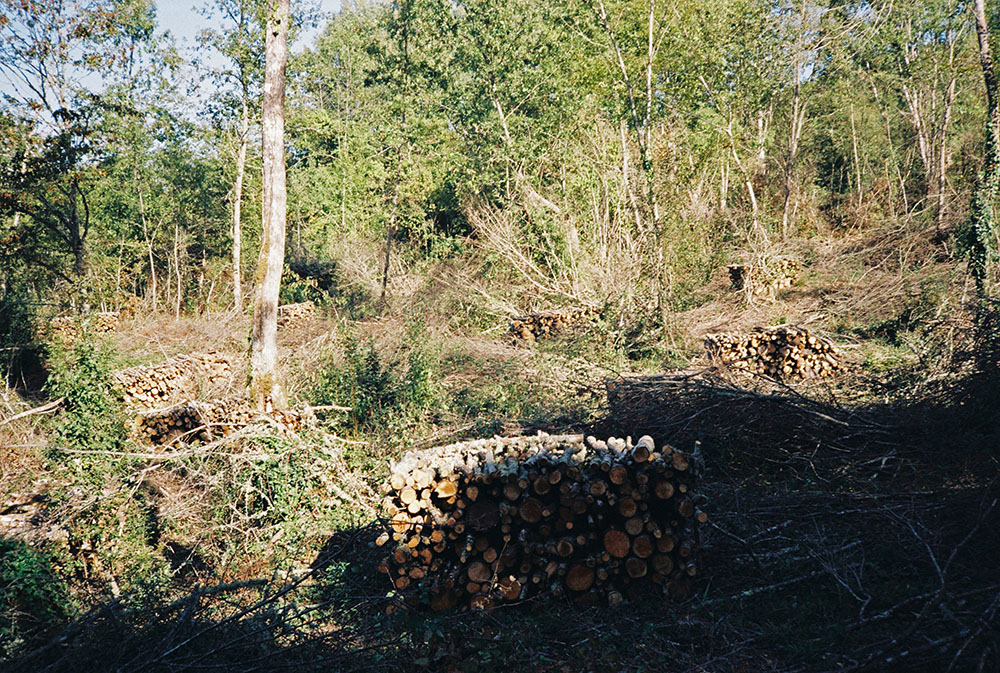
— Thinning in a forest in Tuscany
If a tree poses a safety risk or needs to be removed for another reason, it can be felled. In most cases, felling trees requires a permit, depending on the size and location of the tree. If desired, the necessary permit can be applied for. For information regarding permit requirements or the necessity of felling, you can always reach me by telephone or email.
Felling or dismantling?
When the tree can fall in its entirety in a certain direction — for example, in a forest or large garden — we can fell the tree in a predetermined direction. In more difficult situations where this is not possible, we take the tree down piece by piece; this is referred to as dismantling (sectional felling). When there are obstacles under the tree that cannot be moved, we use ropes to lower each part of the tree, ensuring nothing falls uncontrollably.
If your tree has been damaged following a storm or heavy rain and wind, you can always contact me. Storm damage must always be assessed on a case-by-case basis; sometimes it is a minor issue, but it can also be very complex and dangerous.
Planting a tree is not inherently difficult, especially when using very young plants. However, when you want immediate results and don't want to look at a seedling for the first few years, trees are purchased from a nursery and transplanted into your garden. That transplanting is a fragile moment where, depending on the species, the plants are delivered either bare-root or with a wire root ball. The quality of the soil and any necessary preparations are also crucial to ensure the tree will take root and grow into something beautiful.
Furthermore, it is even more important to make the right choice. A tree that eventually grows too large only causes problems, and if the tree does not suit the soil type in your garden, it will have little future. For advice on choosing the right tree, you can always contact me. I can help you find a high-quality nursery or, if desired, carry out the entire planting process for you.

Tree safety inspection and inventory
If you have trees with defects, diseases, or fungi, a Visual Tree Assessment can investigate the future prospects of the trees. During this process, the condition, any defects, weaknesses, and risks are examined, and necessary measures are proposed.
For larger tree populations or planned construction work near trees, an inventory is the first step. During the inventory, each tree is individually marked on-site, and a Visual Tree Assessment is done for every tree. In this way, you gain insight into the diversity of your trees, making its management and preservation clear, more efficient, and therefore more cost-effective.
Stability research (Pulling test)
Due to carelessness by contractors during construction or a lack of knowledge, the growth place of trees is often seriously disturbed by heavy machinery or excavation work. Damaging structural roots can lead to infections that endanger the future and stability of the tree. To determine the stability of the tree, especially in high-risk locations such as next to a house or road, we perform a pulling test.
During a pulling test, sensors are placed on the trunk and the base of the tree, and a specific force is exerted on the tree using a steel cable. The collected data is then extrapolated and analyzed to provide an assessment of the tree's stability under severe wind conditions.